More and more buying questions are no longer typed into a search box and answered with a list of ten links. People ask ChatGPT, Gemini or Perplexity, or they read the AI summary at the top of a results page and decide from that. These answers share one feature that matters for every business: they usually mention only a handful of brands. GEO is the work of getting onto that short list.
This article explains what is GEO, how it differs from traditional SEO in practice, what decides whether an AI tool cites your site, and how to measure progress without guessing. It is written for business owners and marketing managers, not for engineers.
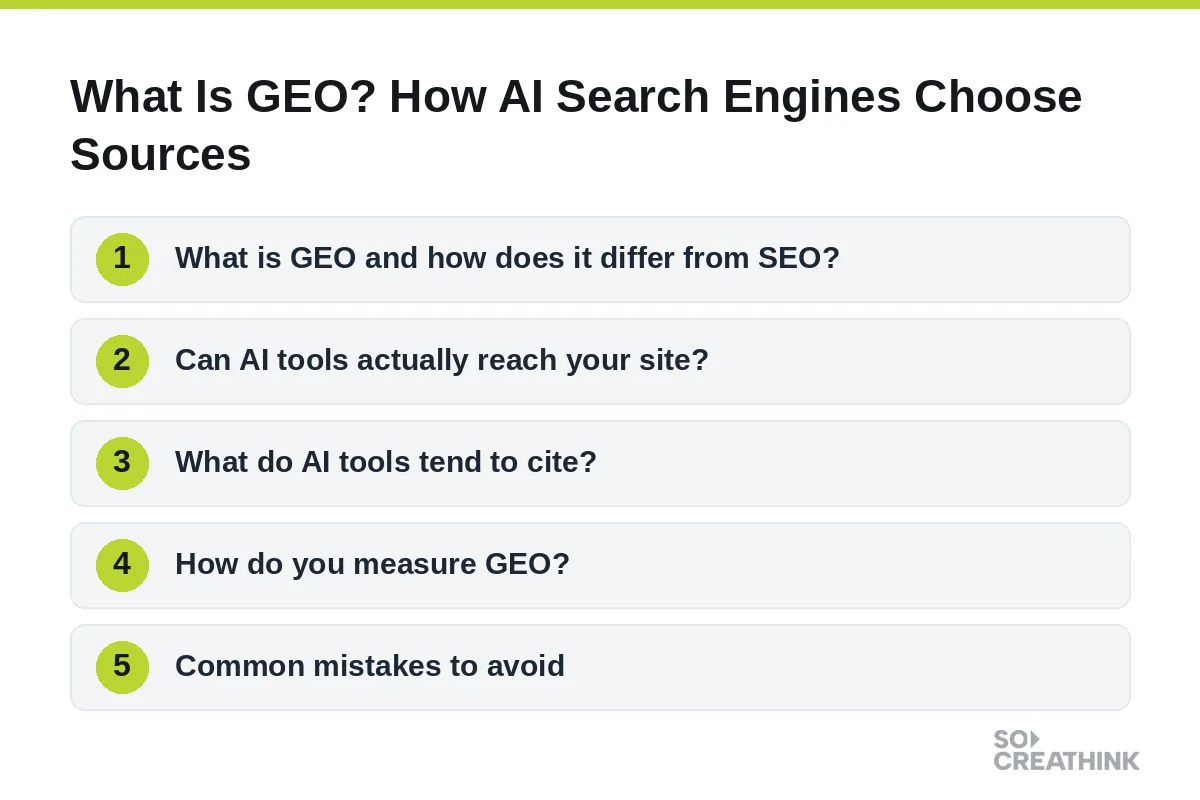
What is GEO and how does it differ from SEO?
GEO stands for Generative Engine Optimization. It is the practice of making your brand and content easy for generative search tools to find, understand and cite inside their answers. Where SEO aims to place a page high in a list of results, GEO aims to have your brand named in the answer itself.
The difference shows up in user behaviour. With classic search, a person sees a list, clicks a result and lands on your site. With an AI answer, the model reads many sources, writes a single response and mentions some of them. The reader may never click anything. Success is therefore measured less by position and more by whether you were mentioned, and in what context.
GEO does not replace SEO. A site that cannot be crawled, loads slowly or hides its text behind scripts is hard for an AI tool to use, just as it is hard for Google. Sound technical SEO is the foundation; GEO adds a few layers on top. If you want to see how the two fit together, our generative engine optimization page describes the approach.
Can AI tools actually reach your site?
This is the problem most businesses never notice. Many sites sit behind a firewall or bot-protection layer that blocks visitors it does not recognise. Googlebot is on the allow list, so Google sees the site normally. Newer AI crawlers are not on that list, so they receive an error. The site owner sees nothing wrong, because opening the site in a browser works fine.
It helps to separate two kinds of bots:
- Answer bots fetch a page at the moment a user asks a question, read it and cite it in the reply. Examples include OAI-SearchBot, ChatGPT-User, Claude-User and PerplexityBot. Blocking these means you stop appearing in those answers.
- Training bots collect content to train future models. Examples include GPTBot, ClaudeBot and CCBot. Allowing or blocking them is a brand-policy decision, and blocking them does not by itself keep you out of live answers.
So "we don't want our content used for training" and "we want to be cited in answers" can both be true at once. The split is made in the robots.txt file by bot name. Writing a permission in that file is not enough, though. You should confirm that a request carrying the bot's identity actually receives a normal response from your server and not a block.
What do AI tools tend to cite?
Nobody outside these companies can state the exact rules, and they change. But several patterns show up repeatedly, and they are practical enough to act on.
A clear answer to a clear question. Pages that ask the question in a heading and answer it in the first sentences are easier to quote than pages that bury the answer in the middle of a long paragraph. If you change only one thing, put the answer first and the explanation after it.
Self-contained blocks. A model often lifts a paragraph or a short list as a unit. A definition, a set of criteria or a short sequence of steps that makes sense on its own is more quotable than a point that depends on three earlier paragraphs.
Structured information. Schema markup, a named author, a publication date and an update date tell a machine what the page is and how fresh it is. They do not guarantee citation, but they remove guesswork.
Text that exists in the raw HTML. Many answer tools do not run a page the way a full browser does. If your key content is only assembled on screen by scripts, the tool may see an empty page. Check what the page contains before any script runs.
A consistent brand footprint. Models read more than your own website. Your business profile, directory listings and mentions in trusted publications form a picture of who you are. When the name, address, services and descriptions disagree across these places, the picture is weaker. For local businesses, a well-kept Google Maps listing is often the quickest consistency win.
Original experience. Content that repeats what everyone else has already written gives a model little reason to pick you. A page that shows your own method, your own measurements or a real case gives it something specific to cite.
How do you measure GEO?
Measurement differs from SEO because there is no ranking report to open. The useful metric is how often you are cited or named for the questions that matter to your business. A simple routine works:
- List the questions your customers genuinely ask. The questions that recur in sales calls are the best source.
- Ask the same questions in several tools, such as ChatGPT, Gemini and Perplexity, on a regular schedule.
- For each answer, record whether your brand appeared, and if it did not, which brands did.
- Repeat monthly and compare the pattern over time.
Treat any single result with caution. AI tools do not give an identical answer to the same question every time, so one test proves little. A trend across repeated tests is far more meaningful. And be wary of anyone who promises a specific citation rate: no one controls these systems, and a claim without a measurement method behind it is not worth much.
Common mistakes to avoid
Several errors come up again and again:
- Assuming access works because the site loads. A browser test says nothing about how a firewall treats a crawler. Test with the bot's identity.
- Rewriting everything at once. Pick the twenty or so questions that matter most and fix those pages first. Changing the whole site makes it impossible to tell what helped.
- Chasing every new tool. The set of AI products changes quickly. The habits that work across them, such as clear answers, accessible text and consistent facts, change slowly.
- Ignoring the basics. Slow pages, broken internal links and thin content weaken both SEO and GEO.
Three steps you can take this week
- Verify access. Confirm that answer bots can fetch your pages and that your firewall is not turning them away. Everything else depends on this.
- Reshape your key pages into question and answer form. Give each important question its own section, with the answer in the opening lines.
- Make your business facts consistent. Align your website, business profile and directory listings so a machine reading them finds the same story each time.
None of these steps needs a large budget. In markets where only a few brands are named in each answer, careful groundwork can be enough to earn a place. If you would like us to check how open your site is to AI tools and report it item by item, see our SEO and GEO work or get in touch.
Frequently asked questions
Will GEO replace SEO?
No. GEO relies on sound technical SEO. A site that cannot be crawled, loads slowly or keeps its content out of the HTML is difficult for AI tools to read as well. They are two goals on the same foundation: a high position in a list on one side, and being named inside the answer on the other.
Will blocking AI bots hurt my site?
Blocking answer bots means you stop being cited in AI answers, but it does not directly change your organic ranking on Google. Blocking training bots does not stop you appearing in live answers. It is best to decide for each family of bots separately.
How long does it take to see results?
Removing an access block can show an effect within days, because answer tools fetch pages when a question is asked. Improvements to content and brand consistency take longer to show up. That is why monthly measurement of trends is more useful than a one-off check.
Is GEO worth it for a small business?
Often yes. Because only a few brands are named in each answer, a small business with clear, accessible content and consistent details can compete without a large budget. For businesses serving a local area, accurate and consistent business information makes a visible difference on its own.