The fastest way to judge an agency is not to read its pitch deck but to ask how it actually works: who will do the work, how success will be measured, and who keeps the accounts and content if the relationship ends. An agency that cannot answer those three questions clearly is a risky choice, however polished its portfolio looks. This guide covers the questions to ask a digital marketing agency at the first meeting, in the proposal, and during the first 90 days, and explains how to read the answers you get.
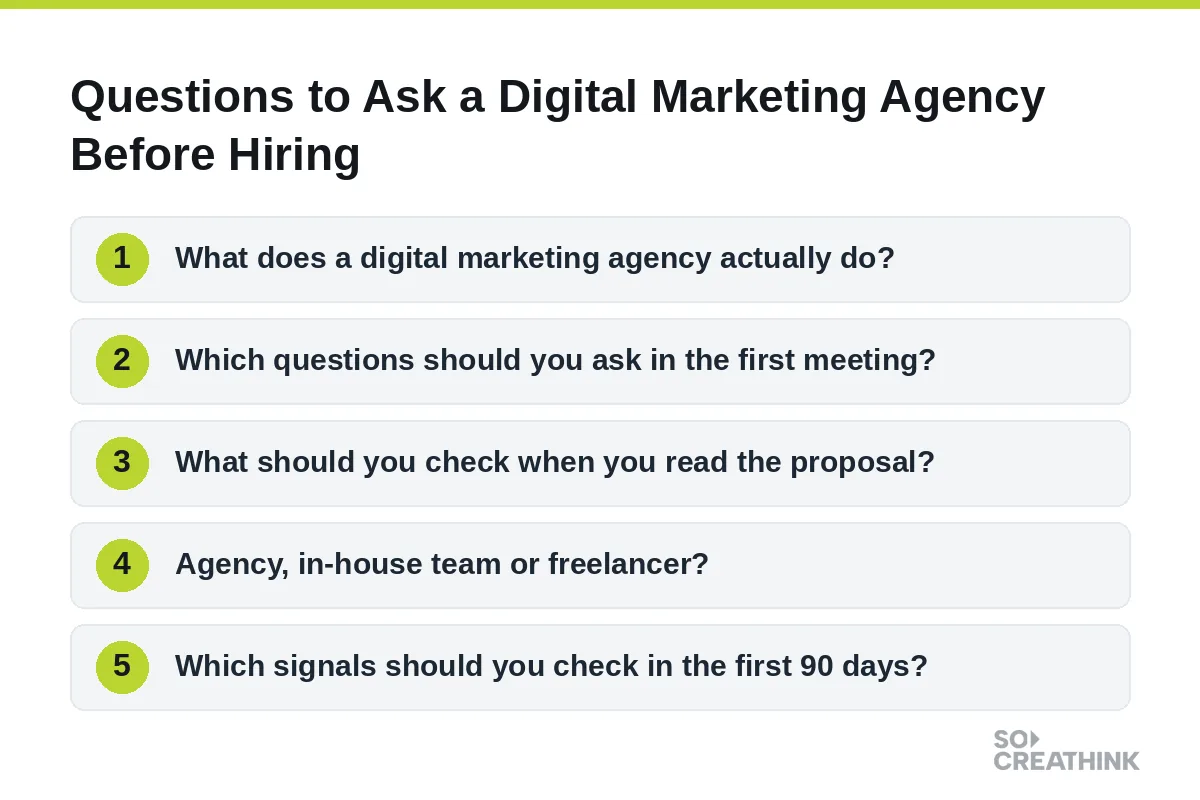
What does a digital marketing agency actually do?
A digital marketing agency manages your brand's visibility online and the demand that visibility produces. In practice that is a bundle of several disciplines: search engine optimisation, setting up and optimising advertising accounts, social media content and community management, website or landing page design, email flows and the tracking that ties it all together.
What matters is not whether an agency sells every one of those disciplines in a single package, but which of them your business genuinely needs. A B2B software company posting twice a day on Instagram may see very little commercial effect, while the same company publishing content for high-intent search queries could see a lot. For a jeweller the picture may be the reverse. If an agency reads out its list of offers without first asking about your sector, your customers and your sales cycle, treat that as an early warning.
If you want a concrete picture of how a typical scope is divided, the headings on our digital marketing page show one way of breaking the work into parts. For a broader explanation of the different agency models, see our article on what a digital marketing agency actually does.
Which questions should you ask in the first meeting?
The introductory meeting works in both directions. The agency is learning about you, and you need to learn a few specific things about the agency. These five questions turn a sales conversation into real information.
1. "Who will work on my account?" Is the team that presents to you the same team that will do the work? If a senior strategist pitches and the work is handed to a junior specialist, you have the right to know that up front. Ask for names, roles and the approximate hours per week assigned to your account.
2. "What will you deliver in the first 30 days?" If you cannot get a clear list of outputs, the planning is weak. A good answer looks something like this: a technical site audit, a keyword map, tracking set up and verified, and a content calendar for the next quarter.
3. "Which metric will define success?" Impressions and engagement are intermediate numbers. The final measure should be something the business cares about, such as enquiry forms, phone calls, purchases or subscriptions. If the agency talks only about reach, its reports will become less meaningful over time.
4. "In whose name will the ad accounts and the domain be registered?" The right answer is yours. When an agency runs campaigns from its own account, you lose the historical data the moment you part ways. You can grant access without handing over ownership.
5. "What did not work on a similar project?" Few agencies answer this honestly, which is exactly why it is such a good filter. A team that can describe a tactic it tried and dropped is a team that actually tests things.
How should you read the answers?
Answers that include concrete numbers, dates and named deliverables are a good sign. Answers that begin with "it depends on the industry" and stop there often hide a lack of preparation. After the meeting, ask for a short summary email. A team that struggles to put the discussion into writing will probably struggle with process management later as well.
It is also worth paying attention to the questions the agency asks you. Good agencies ask about margins, repeat purchases, seasonality and the sales process, because those facts decide which channels make sense. An agency that asks only about your budget is selling a package rather than solving a problem.
What should you check when you read the proposal?
A proposal is the first draft of your working relationship. If the following items are not stated clearly, the proposal is incomplete:
- Scope limits. How many pieces of content, how many graphics, how many landing pages and how many rounds of revisions per month? Be cautious about proposals that say "unlimited".
- Separation of ad spend. Is the agency fee on a different line from the media budget paid to the advertising platforms? If both are merged into one figure, you cannot follow where the money goes.
- Reporting frequency and format. Is it a monthly PDF, a live dashboard, a monthly call, or all three?
- Contract length and termination terms. If a 12-month commitment is requested, ask why. A long term makes sense for cumulative work such as SEO; it is much harder to justify for social media management.
- Handover clause. If you leave, how will content, source design files and account access be returned to you?
When you compare prices, make sure the proposals cover the same scope. A lower monthly fee can end up costing more if content production is excluded. Placing two proposals side by side without matching them line by line produces an illusion of comparison, not a real one.
Our digital marketing agency contract checklist covers the clauses worth settling before you sign, including account ownership, reporting duties and exit terms.
Agency, in-house team or freelancer?
All three can be the right answer, depending on the volume and variety of work.
If you need steady work in a single channel, for example only paid search management, an experienced freelancer is often enough and costs less. The risk is dependence on one person: a holiday, an illness or a job change can stall the whole programme.
When several disciplines are needed at once, such as website, SEO, content and advertising, an agency is usually more efficient. Instead of hiring five specialists separately, you get one coordinated team under one contract. The risk here is divided attention, so it is fair to ask how many clients the agency handles and how your account is staffed.
Building an in-house team is the healthiest long-term option when marketing is the main engine of the business. But recruitment, training and tool licences take several months to set up. A common middle path is to keep strategy and brand knowledge inside the company and outsource production and technical work.
Which signals should you check in the first 90 days?
Most digital marketing work does not produce sales in the first month, but the health of the process is visible from the start. Review this checklist at the end of three months:
- Is tracking in place? Are conversions, form submissions and search interactions being recorded correctly? If not, every other report is a guess.
- Is the calendar being kept? Were the promised content and publications delivered on time, or does everything slip by a week each month?
- Does the report raise useful questions? A good report says what was tried this month, what it produced and what will change next month. A report that only shows charts carries no information.
- Has the quality of traffic changed? Look less at total visitors and more at how many people reach relevant pages and take action.
- Is communication predictable? How quickly are your questions answered, and are you told when something goes wrong?
If three or more of these are failing, ask for a written correction plan before ending the contract. If nothing has changed by the end of the following month, the decision becomes clear.
Setting expectations is part of this period too. A new website may take months to reach the first page for competitive terms; the first signals usually appear in long-tail searches and in technical improvements. Knowing in advance how a search optimisation programme progresses prevents unnecessary impatience and unfair judgement of the agency in month two.
Which warning signs should make you pause?
Some behaviours reveal a problem before the work even begins:
- Guaranteeing a specific ranking or sales figure.
- Being reluctant to share account access.
- Answering strategy questions only with a price.
- Brushing aside a request to speak with a reference client.
- Describing the scope verbally instead of in the contract.
Spotting one of these does not mean you must walk away, but it is a good moment to ask for a written explanation. How the agency responds to a polite request for clarity tells you a lot about how it will handle problems later.
What is the next step?
If you have more than one proposal, put them all into the same scope table: who will work on the account, what is delivered each month, which metric is tracked and what happens when the relationship ends. Once the table is filled in, the decision often becomes obvious by itself.
If you would like to talk through which channels matter most for your own situation, you can reach us through our contact page and we will go through your current site and goals together.
Frequently asked questions
How is the cost of working with a digital marketing agency determined?
Pricing usually depends on three variables: the number of channels covered, the monthly production volume (content, design, campaigns) and the time the team dedicates to your account. The advertising budget sits outside this fee and is paid directly to the platforms. When you request a proposal, ask for these two items on separate lines.
How long does it take to see results?
It depends on the channel. With paid advertising the first data arrives within days, but reaching a well-optimised setup takes several campaign cycles. SEO and content marketing are cumulative, and meaningful organic movement is measured in months. Choose the contract length with that difference in mind.
What should I take with me when I change agencies?
Advertising accounts, analytics and search console access, domain and hosting details, the email list, and the source files of the content and designs that were produced. Preparing this handover list when the contract is signed prevents arguments at the end.
Is an agency too early a step for a small business?
If the budget is limited, going deep in one channel is usually more effective than opening all channels at once. A local business, for example, may get faster results from a solid website, map visibility and a few landing pages than from a broad package. You can start with a narrow scope and widen it later.