Digital marketing agency pricing cannot be read off a single price list, because the fee follows the scope of work. A quote usually has two separate parts: what you pay the agency for its time and expertise, and what you pay advertising platforms for media. The agency fee itself is set in one of four ways: a fixed monthly retainer, a percentage of ad spend, performance-based pay, or a fixed price per project. This article explains how agencies build that number, which decisions push it up or down, and how you can make a rough estimate of your own before you ask for proposals.
The first question most owners ask is "what will this cost?" Be careful with both extremes. An agency that refuses to discuss cost until the very end is hard to plan around, and one that names a precise figure in the first call, before asking about your goals or channels, has probably priced a package and not your problem.
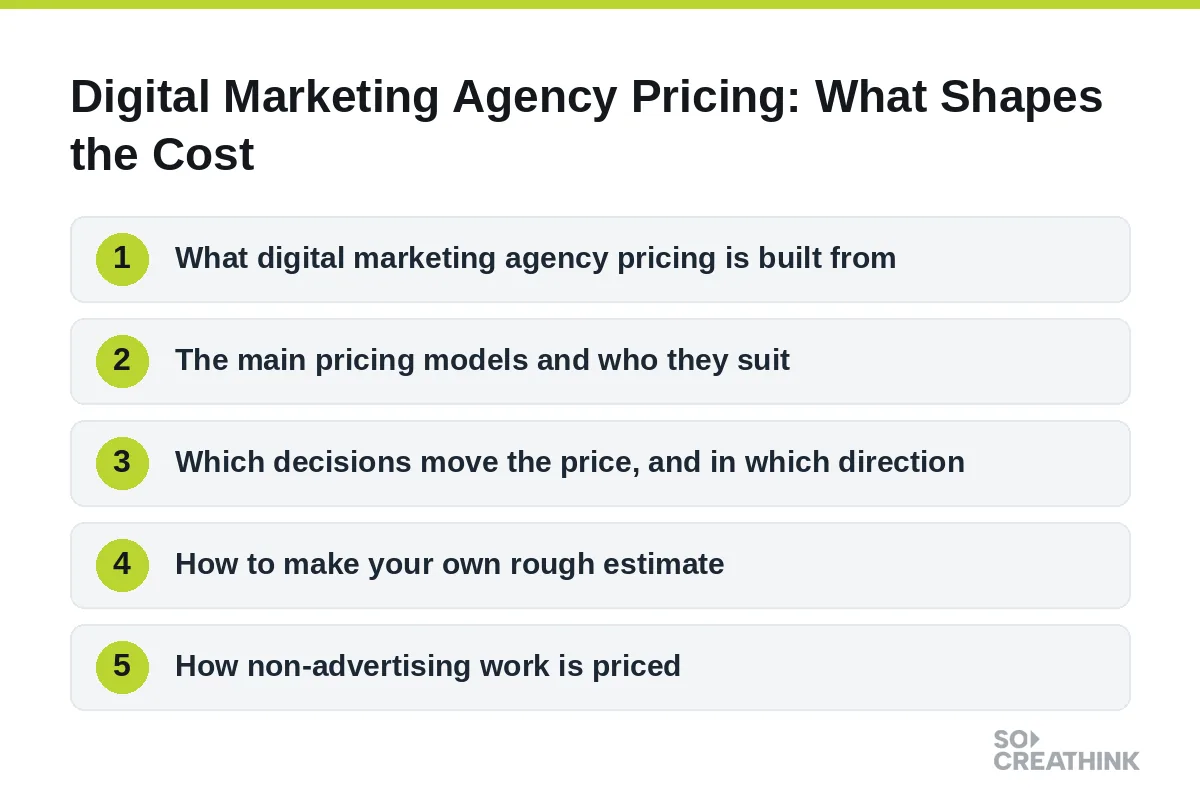
What digital marketing agency pricing is built from
Every proposal, however it is presented, is a combination of the same few ingredients.
The size of the media budget. The more advertising spend an agency manages, the more campaigns, tests and reporting it has to run. Managing a modest budget in one account is a different job from managing a large one split by product line, region, device and audience, because each split becomes its own campaign with its own tracking.
The number of channels. Running only paid search is one job. Running paid search, paid social, SEO and email together is several jobs that each need their own setup and reporting. Adding a channel usually raises cost sharply in the first month, when accounts are built and tracking is configured, and then settles into a steady maintenance load.
Content production. Ad creative, video editing, social posts and articles are often the most variable line in a proposal. A plan with a handful of static images each month and a plan with a regular flow of images, short videos and written pieces are priced very differently, even if both describe themselves as "social media management".
Where you are starting from. If your accounts have never been set up, or were set up badly, the first month includes cleanup. A site that does not measure conversions needs measurement before it needs ads, and that work normally appears as a separate setup line.
Seniority of the team. Agencies cost their work in hours. A senior strategist on your account every week costs more than a junior specialist supervised occasionally. Neither is wrong, but you should know which one you are paying for.
The main pricing models and who they suit
Fixed monthly retainer. The scope is written down and the fee is flat. It gives you predictability, and work outside the agreed scope is quoted separately. This model suits businesses whose channels and spend are fairly stable from month to month.
Percentage of ad spend. The agency takes an agreed share of the budget it manages. There is no standard rate, since every agency works from its own cost structure. The model tends to work for larger and steadier budgets; for smaller or fluctuating ones, agencies often add a minimum fee so that the percentage covers the real effort. One thing to watch is incentive: a percentage model can reward growing the budget rather than improving results, so agree on which performance indicators the agency will be judged on.
Performance-based pay. Part of the fee depends on outcomes, such as leads or sales. This only works when tracking is solid and both sides agree on what counts as a conversion. Do phone orders count? What about refunds and duplicate form submissions? A business whose measurement is still immature is usually better off with a different model first.
Project-based pricing. A website build, a one-off technical SEO audit or a landing page design has a clear start and finish, so it can be priced as a project. It works well when the deliverables and the number of revision rounds are written into the agreement.
Many real proposals blend two of these, for example a retainer for ongoing management plus a project fee for a website build.
Which decisions move the price, and in which direction
Exact figures depend on scope, but you can see in advance how your own choices will push a quote:
- Adding a channel raises the first month noticeably and the following months slightly. Setup happens once; maintenance continues.
- Increasing content volume raises the fee directly and permanently, because production time is the easiest cost to measure.
- Raising the media budget often leaves a flat retainer unchanged but raises a percentage-based fee in proportion.
- Setting up measurement yourself can lower the first month, with little effect afterwards.
- Asking for more frequent reporting adds a small but recurring cost; a weekly report is more hours every month than a monthly one.
- Requesting a more senior team lifts nearly every line, since the fee is built on hourly cost.
How to make your own rough estimate
You can run a simplified version of the calculation agencies do internally.
- Split the scope into work items. Campaign management, creative production, content writing, reporting, meetings and technical fixes.
- Estimate hours per item per month. Two hours a week of campaign optimisation is roughly eight hours a month. For content, count research, drafting, editing and design separately, because a finished article is the sum of all four.
- Estimate a cost per hour. Look at typical salary ranges for the relevant roles in your market and add the employer's on-costs.
- Allow for overhead and margin. Software licences, management and sales time and the agency's margin sit on top of the raw cost. The agency does not have to disclose its exact multiplier, but you can ask which tools and meeting hours are included in the fee.
The result will not be a price, but it will tell you which order of magnitude a reasonable proposal should fall in. A fee far below what the scope's hours would cost is a reason to ask what has been left out.
How non-advertising work is priced
SEO, content, web development and email do not involve a media budget, so percentage models make little sense. They are normally priced as monthly retainers or project fees.
- SEO is made of separate pieces: a technical audit (a one-off cost that grows with the size of the site), ongoing technical maintenance, content production and sometimes developer time. What drives cost is less the number of keywords tracked than the number of pages that are produced or fixed each month. You can see the usual building blocks on our SEO service page.
- Content is priced by length, depth of research, whether specialist input is needed and whether visuals are included. A technical article for a specialist audience takes longer than a general guide.
- Web design and landing pages depend on the number of distinct templates, how much is custom design, integrations such as payments or a CRM, and how many revision rounds are included. The number of distinct templates is a better predictor than the number of pages.
- Email and automation depend on the number of flows and templates. The software licence is usually separate from the agency fee.
Costs that sit outside the agency fee
Check whether a quote includes sales tax or VAT, because two proposals are only comparable when both are shown on the same basis. Rules on tax for advertising spend and on services bought from foreign platforms differ from country to country, so confirm the treatment with your accountant rather than assuming it.
Tools are the other hidden line. Email platforms, heatmap software, stock-image subscriptions and hosting are sometimes part of the retainer and sometimes billed to you. The contract should say whose account pays for each one.
Questions to ask when you get a proposal
- Is the media budget included in the fee, or paid separately and directly to the platform?
- Whose name will the ad accounts, analytics and domain be registered in? (The answer should be yours.)
- What exactly will the monthly report contain, and how often will it arrive?
- How will work outside the agreed scope be priced?
- Who will actually do the work, and how many people will look after the account?
- How long is the commitment, and what are the exit terms?
Do not skip the last one. An agreement without written exit terms leaves your only way out to negotiation at the moment things are going badly. Our guide to the agency contract checklist goes through the clauses worth checking.
When you place two proposals side by side, compare the scope lines before you compare the totals. A cheaper proposal is often cheaper because something is missing: less content, less frequent reporting, a more junior team, or software licences left for you to buy. If you want to understand how those scope lines are normally divided, the digital marketing services overview shows a typical breakdown, and our article on what an agency actually does explains the work behind each line.
Frequently asked questions
Does digital marketing agency pricing include the advertising budget?
Usually not. The agency fee is invoiced by the agency, while the media budget is paid to the platform, such as Google or Meta. If a proposal shows a single combined figure, ask for it to be split so you can see how much reaches the audience.
Is it worth hiring an agency on a very small budget?
When the budget is small, the management fee and the ad spend come out of the same pot, so efficiency drops. It is usually more realistic to start with one channel, get measurement right and leave extra content production for later, then widen the scope once there is something to build on.
How long should the contract be?
Setup and measurement rarely finish in the first month, so a one-month deal is awkward for both sides. Starting with a commitment of a few months and renewing by period is common. Whatever the length, a written right to exit with notice should be part of the agreement.
Why are SEO and advertising priced differently?
Advertising has a media budget that a percentage or a flat fee can be tied to. In SEO, what is being bought is effort: technical fixes, content and developer hours. SEO fees are therefore based on monthly workload or project scope.
Next step
If you already have a rough scope, you can share it with us and we will tell you plainly which parts drive the cost. If you do not, it is more useful to start from your goals and decide together which channels make sense. You can reach us through the contact page.