Most businesses spend weeks comparing proposals and ten minutes on the contract. That is backwards. The proposal describes what an agency hopes to do; the digital marketing agency contract describes what it is actually obliged to do, what happens when results disappoint, and what you walk away with if the relationship ends. A few vague clauses signed in week one tend to surface six months later as the question "why can't we get our ad account back?"
This guide walks through the clauses worth reading line by line, the wording that should raise an eyebrow, and a short list of questions to settle in writing before anyone signs. It is general information, not legal advice; for long or high-value engagements, have a lawyer read the final text.
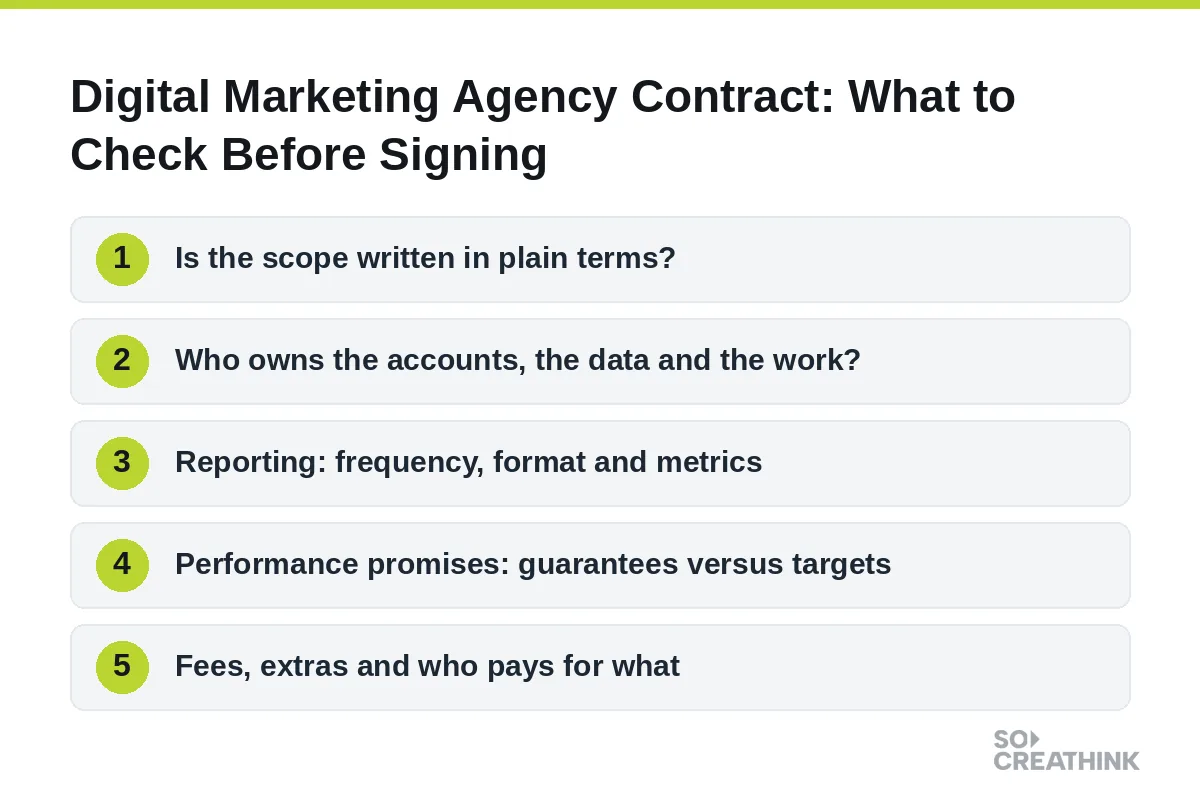
Is the scope written in plain terms?
Disputes usually begin with a phrase like "digital marketing services". It sounds complete and means almost nothing. A solid contract names each channel that is in scope (search optimisation, paid media management, social, content, email) and, just as importantly, says which ones are not.
Look for countable detail. If SEO is included, how many pages or keyword groups will be worked on each month, and does that include technical fixes or only recommendations? If paid media is included, is the ad budget inside the agency fee or billed separately, and who decides how it is split between campaigns? If content is included, how many pieces per month, at what length, and who writes, edits and approves them?
Broad wording such as "general marketing consultancy" is a red flag, not a safety net. It leaves both sides free to argue later about whether a given task was ever promised. If the proposal mentions something the contract does not, ask for it to be added or struck from the proposal.
Who owns the accounts, the data and the work?
This is the clause that costs the most when it goes wrong. The principle is simple: advertising accounts, analytics properties, domains and similar assets should be created in your company's name, with the agency given administrative access. Some agencies run campaigns from accounts they own, which can leave you without your own performance history when you leave.
Check the contract for explicit answers to these points:
- Whose name is on the advertising accounts, the analytics property, the tag manager and the search console verification?
- Who holds the domain and hosting records?
- Who owns the copyright in produced content, designs, ad creative and, if the agency builds your website, the code?
- On termination, are all logins, files and source documents handed over, and within what time frame?
The usual expectation is that work you have paid for belongs to you. Some contracts blur this, or tie ownership to a licence that ends with the relationship. If a clause says the agency keeps rights in anything it produced, ask exactly what that covers and whether you can keep using the material after you leave.
Reporting: frequency, format and metrics
"Regular reporting will be provided" promises nothing you can enforce. Good wording states how often reports arrive (monthly is common, sometimes more often during launch), which metrics they include and in what format, and whether a call to discuss them is part of the arrangement.
Metrics deserve their own attention. Impressions, reach and follower counts show that activity happened; they do not show that it worked. Ask that the contract or its appendix define what counts as a conversion (a form submission, a phone call, a purchase), how it is measured, and whether branded searches, the people already looking for you by name, are separated from new demand. When SEO reporting is part of the scope, that split is one of the clearest ways to see whether the work is bringing in new visitors or simply counting existing ones.
Also ask who will prepare the reports and whether that person can explain them. A report nobody on the agency side can discuss is decoration.
Performance promises: guarantees versus targets
Be careful with any document, or any sales call, that guarantees a specific result by a specific date, such as "first page of Google in three months". No agency controls search engine rankings or ad auction prices. Competitors move, platforms change their rules, and your own site and offer matter as much as the agency's effort.
That does not mean a contract should contain no goals. Reliable wording looks like measurable, process-based targets: which pages will be optimised, which tests will be run, which conversion events will be tracked, and what the review points are. If results-based fees are offered, read exactly how the result is defined and measured, over what period, and who has access to the numbers used to calculate the fee.
A useful test: if the agency does everything the contract says and the outcome is still disappointing, does the contract say what happens next? Good agreements include a review mechanism rather than pretending uncertainty does not exist. For the wider picture of what agencies promise and deliver, our overview of what a digital marketing agency actually does is a helpful companion.
Fees, extras and who pays for what
A transparent fee clause answers four questions. Is the fee a fixed monthly amount, a project price or performance-linked? What does it include, and what is billed on top (extra campaigns, urgent revisions, additional rounds of design)? Is the media budget separate, and does the agency take a percentage of it? When and how can the price change, particularly on renewal?
Surprise invoices rarely come from dishonesty; they come from a task nobody defined. The cure is a short price list for common extras, agreed in advance, and a rule that out-of-scope work needs written approval before it starts. Revisions follow the same logic: say how many rounds of changes are included in each deliverable and how further rounds are handled.
Term, renewal and termination
Nobody signs a contract expecting to leave, yet termination wording is where a contract proves its worth. Read these items closely:
- Minimum term. Work such as search optimisation takes time to show effects, so a minimum commitment of several months is common and reasonable. What matters is that the length is proportionate and the conditions are fair.
- Early exit. Is there a notice period, and is there a penalty? Is it the same for both sides?
- Automatic renewal. If the agreement renews itself, how long before the end date must you give written notice? Missing that window can bind you to another term you did not intend.
- Handover. What is transferred at the end, in what form, and by when? This is the clause that ties back to account ownership.
If the notice period is long and the exit penalty heavy, it is worth asking why. A confident agency can usually accept a fair exit clause because it expects to keep clients by delivering work, not by locking them in.
Confidentiality and data protection
An agency will see your customer lists, sales figures, ad accounts and, often, the back end of your website. The contract should say how that information is stored, who inside the agency can see it, whether subcontractors or third-party tools are involved, and what happens to it when the engagement ends. Confidentiality should run in both directions, protecting your commercial information and giving the agency reasonable protection for its own methods.
If personal data is involved, for example contact details collected through forms or customer records shared for campaigns, the roles and responsibilities of each side should be defined under the data protection law that applies to you, such as GDPR in the European Union or KVKK in Turkey. If the agency uses subcontractors, ask that the same obligations apply to them and that you are told who they are.
Communication and continuity
The day-to-day experience of an agency depends on things contracts often skip: who your contact is, which channel you use, how quickly requests are answered, and who to call if an ad account is suspended or the site goes down at a bad moment. These need not be rigid service levels, but a named contact and an agreed response window are reasonable to ask for.
Ask also what happens if the people assigned to your account change. The person you meet during the sales process is not always the person who does the work. A simple obligation to notify you of staff changes and to manage a proper handover protects continuity at almost no cost to the agency.
Questions to settle in writing before you sign
If any of the following is unclear in the contract, get the answer in writing:
- Which services and outputs are in scope, and what falls outside it?
- In whose name are the advertising, analytics and domain accounts held?
- Who owns the content, designs and code produced?
- What will be reported, how often, and how is a conversion defined?
- How are fees structured, what counts as an extra, and how is the media budget handled?
- What are the minimum term, notice period and renewal rules?
- What is handed over at the end, and by when?
- How is your data protected, and who else can access it?
If you would like to see how a scope can be written clearly, you can read about our digital marketing services or ask us to talk through your own draft agreement.
Frequently asked questions
How long should I take before signing an agency contract?
Take as long as you need to clear up unclear clauses. A reputable agency expects questions and will put clarifications in writing. Pressure to sign quickly is itself useful information.
Is a minimum commitment period normal?
Yes, especially for services like search optimisation where results build over months. The length should be reasonable for the type of work, and the exit terms should be fair to both sides.
Why does account ownership matter so much?
Because the account holds your history: campaign data, audiences, tracking and learning. If the account sits under the agency's own umbrella, you may lose all of that when you leave. Accounts opened in your company's name, with the agency given access, avoid the problem.
Can I trust an agency that guarantees results?
Treat guarantees of specific rankings or dates with caution. Realistic agencies set measurable targets, define how progress is reviewed and explain what is outside their control.
Do I need a lawyer to review the contract?
For long-term or high-budget engagements, a legal review is a sensible precaution. For small, short projects, a careful read against the checklist above often covers the main risks, but the decision depends on your situation.