Ask a search engine "how much does a corporate website cost" and you get a page of links. Ask an AI assistant the same question and you get one written answer, often assembled from several sources. Generative engine optimization (GEO) is the work of making your content one of the sources those answers draw on.
It shares a goal with classic SEO, which is being found by the right people at the right moment, but the methods and the way you measure success differ in important ways. This article compares the two side by side: what each aims for, how content is structured, which authority signals matter, how results are tracked, and what a sensible first step looks like.
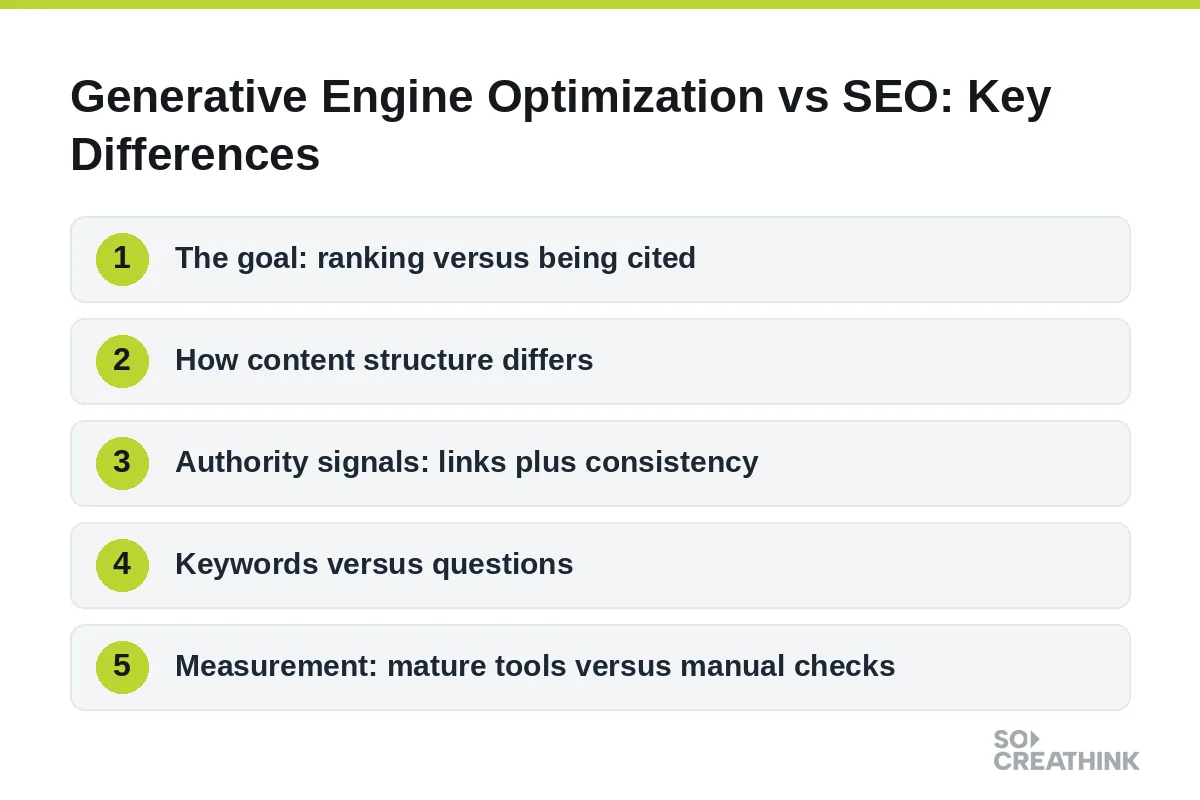
The goal: ranking versus being cited
Traditional SEO is measured mostly through position. You aim to appear on the first page for a given query, ideally near the top. The user sees a list and chooses.
With generative engine optimization, there is no list in the same sense. An AI system composes an answer, and the question becomes whether your page is used as a source or mentioned in that answer. Visibility means being included in the response rather than occupying a numbered slot.
This changes how you look at success. For SEO you check where a page ranks for a keyword. For GEO you ask: when someone asks about this topic, does the assistant refer to us? Both are visibility work, but they look at different places.
How content structure differs
A page that does well in classic search is usually comprehensive: it covers a topic in depth, uses relevant terms naturally and answers related questions. Length and coverage often help.
Generative systems read pages differently. They look for passages that can be lifted out and still make sense, so clarity and extractability matter more. In practice that means:
- Defining the topic in the first sentences instead of building up to it.
- Writing paragraphs that stand on their own without relying on the previous one.
- Using clear question-and-answer blocks for common questions.
- Supporting statements with concrete detail, not vague claims.
None of this hurts classic SEO. A page that answers a question plainly is better for human readers too. The difference is that for GEO, this clarity moves from "nice to have" to "central".
Authority signals: links plus consistency
In traditional SEO, authority is strongly tied to backlinks, meaning how many trustworthy sites link to yours. That still matters.
For GEO, a second layer becomes important: consistency of information about your business across the web. If your name, offering and contact details read one way on your site, another in a directory and a third on social profiles, an AI system has a harder time deciding which version to trust. Consistent, verifiable details across the places that describe you make your business a more dependable source.
This means GEO is not only about one website. It covers your wider digital footprint: your own pages, business listings, mentions in industry sources and profiles. Local businesses should pay particular attention to keeping listings aligned, and our Google Maps listing work exists for exactly that purpose.
Keywords versus questions
Classic SEO often starts with a short keyword, such as "web design agency", and builds a page around it. People using AI assistants tend to ask longer, more specific questions: "What kind of website suits a small restaurant, and how should I plan the budget?"
A single keyword cannot capture a question like that. So with GEO, content planning shifts from one term to a cluster of questions around a topic: what a reader is likely to ask before and after the main question. Each of those can become a heading or a short answer block on the page. A well-built page can then serve both classic queries and the many ways the same question is asked in conversation.
Measurement: mature tools versus manual checks
Rank tracking in SEO is well established. Dozens of tools report positions daily, and Search Console shows impressions and clicks directly.
GEO measurement is less standardised. At the moment, the most practical approach is fairly manual: pick a set of questions that matter to your business, ask them to AI assistants at regular intervals, and note which sources are mentioned. Over weeks you can see whether your brand appears more often and in what context.
That does not make GEO unmeasurable; it means the tooling is younger. Because checks are manual and answers can vary from one session to another, it is wiser to judge progress over several weeks than to react to a single result.
Do you need to choose one?
No. The two overlap far more than they compete. Technical foundations such as fast loading, sensible headings, mobile-friendly pages and crawlable structure help in both worlds. Well-organised, clear writing helps both too.
The healthiest approach for most businesses is to keep a solid SEO base and add GEO practices on top of it. If your technical basics are weak, fix them first; there is little point optimising for AI answers when the page is slow, thin or hard to crawl. Our SEO page describes how that foundation is usually built, and our generative engine optimization page covers the additional layer.
A practical first step
You do not need to rewrite a whole site. A modest, ordered start works well:
- Choose the few pages that bring the most visits or enquiries and begin there.
- Open each with a short, direct summary of what the page covers.
- Add a frequently asked questions section with plain, short answers.
- Check that your business name, address and descriptions match everywhere they appear.
- Choose a handful of target questions and ask them to AI assistants every few weeks, noting what comes back.
These steps take little time and improve the page for human visitors as well.
Mistakes to avoid
The most common mistake is writing a separate, simplified version of content "for AI". The pages these systems use as sources are usually the ones that already help real readers. Stripping text down or repeating the same phrasing over and over makes pages worse for people and does not make them more trustworthy.
A second mistake is making bold claims that cannot be verified. Clear, checkable information tends to look more reliable to readers and to the systems that evaluate content.
The third is impatience. Search engines and AI systems both take time to reassess content, so give changes several weeks before judging them.
Frequently asked questions
Do I need a separate website for generative engine optimization?
No. You work on your existing site by making definitions clear, adding question-and-answer sections and keeping paragraphs self-contained. No separate technical setup is required.
How can I tell whether GEO is working?
Right now the practical way is to ask relevant questions to AI assistants regularly and note whether your brand or pages are cited. Compare the notes over several weeks rather than from a single check.
Should a small business prioritise GEO over SEO?
Usually SEO fundamentals come first. If the technical base and core content are not solid, GEO has nothing to build on. Think of it as a layer added once the foundation is in place.
Does GEO replace traditional SEO?
No. They work together, and most improvements that help one also help the other.
Next steps
If you want to understand how your site currently looks from both angles, classic search and AI-generated answers, our team can review it and suggest priorities. You can reach us through the contact page.