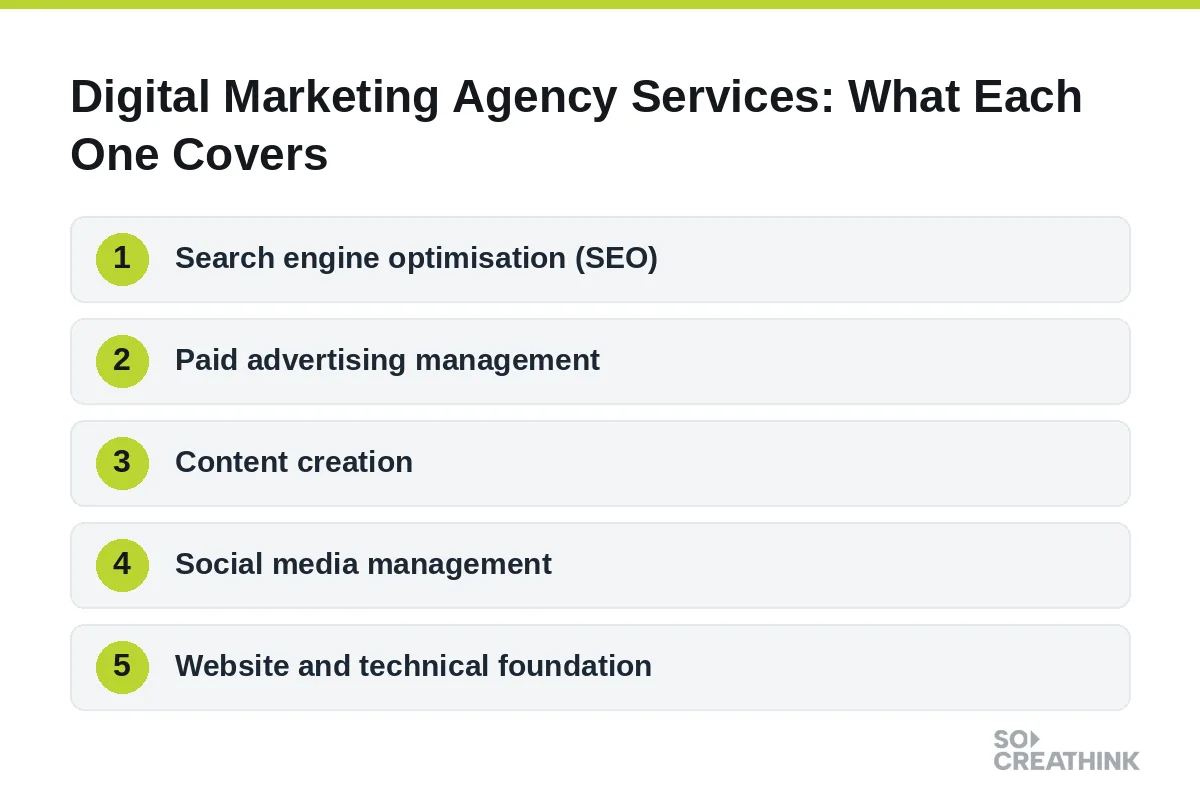
The phrase "digital marketing agency" does not describe one offer. It covers a group of different disciplines, and agencies combine them in different ways. That is why quotes from two agencies can look nothing alike: one manages only social media, another only manages an ad budget, and a third offers everything from search optimisation to content.
This guide goes through the digital marketing agency services you are most likely to be offered, explains what each one involves and how it is measured, and helps you decide which ones a business needs first. It is meant for owners and managers who are about to compare proposals.
Search engine optimisation (SEO)
SEO aims to increase your visibility in organic search results, meaning the results you do not pay for per click. It usually breaks into three parts. Technical SEO deals with how the site is built: loading speed, mobile layout, whether pages can be crawled and indexed. Content SEO covers the pages and articles that answer what people search for. Authority work covers the signals from other sites and profiles that show your business is credible.
The pace of SEO is slower than paid advertising, and the effect is more durable. Results are normally judged over months, not days. If you want to see how this is delivered in practice, our SEO page describes the scope.
Paid advertising management
Paid advertising covers search ads, display ads and social media ads. An agency running this work handles budget allocation, audience definition, ad copy, landing pages and ongoing adjustments. The big difference from SEO is timing: ads can bring traffic as soon as they are live, but the traffic stops when the budget stops.
For many businesses the two channels work best together. Ads give quick visibility while organic work builds. If you are weighing a campaign, our Google Ads page will help you judge what a sensible start looks like.
Content creation
Content includes blog articles, pages for what you sell, social posts and video scripts. It is a specialist area because it feeds both search visibility and your credibility with readers. A good agency does not publish at random. It plans which question each piece answers, who it is for and where it leads next.
When you review a proposal, ask how many pieces are included per month, who writes and checks them, and how subject-matter accuracy is handled. A fixed number of articles with no plan behind them is not the same as a content offer.
Social media management
This usually includes a posting calendar, keeping the brand voice consistent, replying to comments and messages, and producing campaign-based content. Social media is better at building awareness and keeping a relationship with existing customers than at producing direct sales on its own. Sales are more likely when it runs alongside search and advertising.
Be clear about what is included. Community management, meaning replying to people, is often a separate line from content creation, and paid promotion of posts usually sits in the advertising budget, not in the management fee.
Website and technical foundation
Some agencies include web design and development. Site speed, mobile behaviour and ease of use affect both organic visibility and how many ad clicks turn into enquiries. For this reason the website is often handled together with the other disciplines. If you need a new site or a rebuild, see our web design page.
It is worth asking whether the site is built so that you keep control of it: who owns the hosting, the domain and the content management account, and what happens if you part ways with the agency.
Analytics and reporting
Every activity above has to be measured. Search Console, analytics tools and ad dashboards are how you find out which channel produces results and which does not. A useful report shows actions in plain terms: what changed, what it led to, and what happens next. A report that is only a list of impressions and clicks without a link to your goals is of limited use. For a closer look at what to expect from reporting, read our article on what a digital marketing agency does.
Which one do you need first?
The right order depends on where the business stands and what it wants.
A new business with little brand recognition usually begins with a solid website and basic SEO, because organic visibility takes time to build. When you need quick results for a launch or seasonal campaign, advertising moves up the list. Once the brand has settled, content and social media help build longer-term relationships.
Most businesses do not need every discipline at full intensity at the same time. A small company serving a local area might focus first on its local presence and a clear website. An online shop selling nationally may start advertising and content earlier. If the budget is limited, opening them one after another rather than all at once is sensible: it lets you see what each channel contributes on its own.
How to question the scope in a proposal
Asking "what do you offer?" is not enough. An answer such as "we do SEO" does not tell you whether that means technical work, content production or only keyword reports. Make each answer concrete. In the meeting, ask for clarity on points like these:
- Which items are in the monthly fee and which cost extra
- How often reports arrive and what data they contain
- Whether the advertising budget is separate from the agency fee
- How many content pieces per month are included, and who approves them
- Which parts are done in-house and which are outsourced
If these points are not settled before you sign, a disagreement about "who pays for this" tends to appear a few months in. A written scope is a more reliable guide to an agency than a list of past clients. Our digital marketing page sets out how we describe ours.
Frequently asked questions
Do I have to buy everything from one agency?
No. Some businesses use one team for SEO and another for advertising. Because the channels support each other, a single team can make coordination easier, but it is not required.
What should a small budget go to first?
With limited funds, technical SEO and a basic set of useful content are common starting points, because their effect continues after you stop spending. Advertising is better when you need fast visibility and can fund it continuously.
Does social media management produce sales?
It mainly builds awareness and trust. Direct sales tend to increase when social media works together with search and advertising.
Does an agency do everything with its own staff?
It varies. Some agencies keep all disciplines in-house, while others bring in outside specialists for areas such as video production. Ask at the proposal stage who will actually do the work.
How are priorities decided?
They follow the current state of the business, such as new or established, and the budget and goal, whether awareness or sales. A short discovery conversation should end with a clear order of work, not a package of everything.
If you would like to talk through which of these fit your situation, you can reach us through our contact page.