When a business decides to grow its marketing, it has three realistic routes: hire an in-house team, work with freelancers one task at a time, or bring in an agency. All three can be the right answer. Which one fits depends less on company size than on how many channels need to run together and how much management time the owner can spare. The benefits of working with a digital marketing agency are real, but they are specific, and they only show up under certain conditions. Knowing which ones apply to you makes proposals much easier to compare than looking at price alone.
This article walks through the practical advantages, the situations where they matter most, and the circumstances in which an agency is not the best choice.
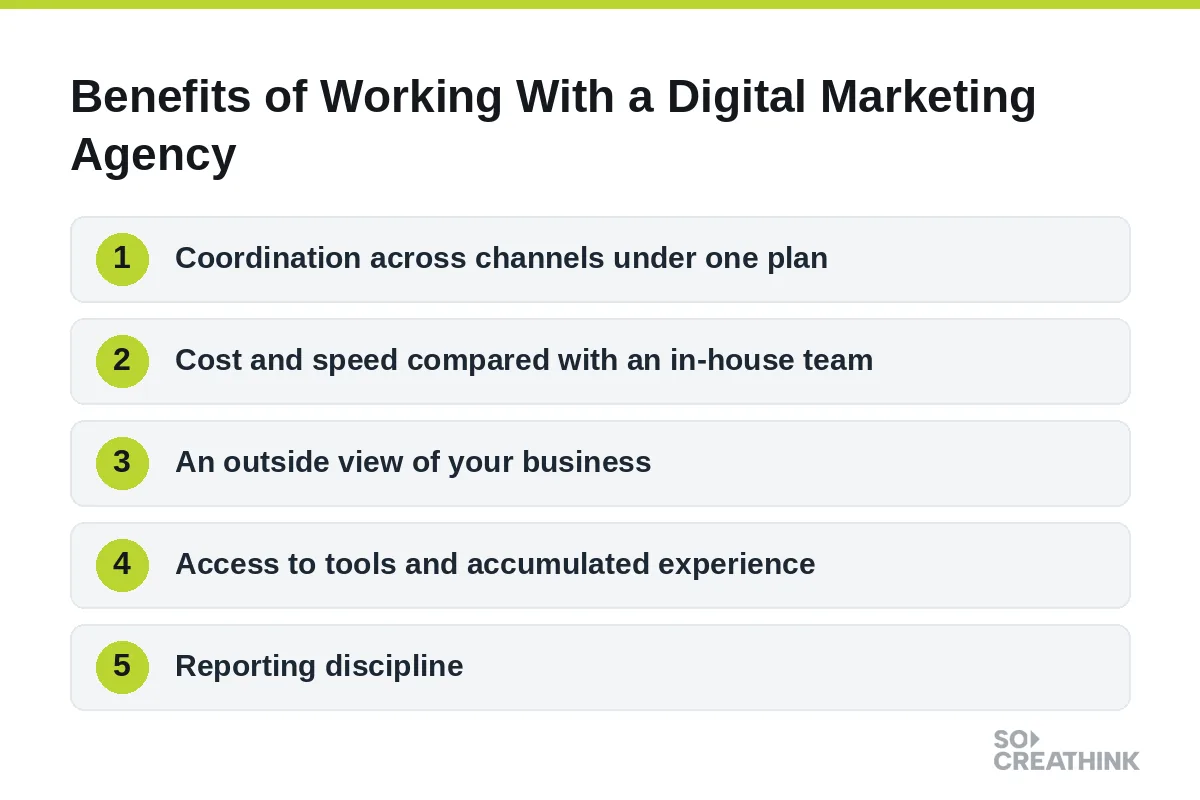
Coordination across channels under one plan
Advertising copy, landing pages, search optimisation and email sequences often sit with different people. When they do, the job of making them agree with each other falls to the business owner. An agency can tie these channels to a single plan, so the offer promoted in an ad is the same one the landing page repeats, and the articles written for search do not contradict the keywords chosen for paid campaigns.
The benefit grows with the number of channels. A company that runs one channel, such as a simple search campaign, gains little from this coordination, and a capable freelancer may be enough. Once three or more channels need to work as a system, the cost of coordinating them yourself becomes visible in missed deadlines, mixed messages and duplicated effort.
It also removes a management burden. Instead of briefing a designer, a copywriter, an ad specialist and a technical SEO separately, you brief one team and review one set of results.
Cost and speed compared with an in-house team
Hiring a search specialist, a paid media manager, a content writer and a designer means four salaries plus the time needed to recruit, manage and train them. An agency that already employs those skills can deliver comparable coverage for a fixed monthly fee, because the same expertise is shared across several clients rather than carried full time by one.
Speed matters just as much. A new employee needs weeks to learn the tools, the processes and the industry. An agency starts with tools already configured, templates that have been tested and lessons from earlier projects. That usually shortens the time from signing to the first live campaign or the first published content calendar.
Be careful with the comparison itself. The fair way to weigh the two options is to fix the scope first and price both against the same list of tasks. If the agency fee grows as the scope grows, that is expected; the question is whether the same scope would cost more to build internally once salaries, tools and management time are counted.
An outside view of your business
Teams that live inside a company get used to its product and its language. That familiarity can turn into a blind spot. An agency sees the business the way a visitor does: which sentence is unclear, which offer looks identical to a competitor's, which page makes people leave.
This outside perspective is most useful for messaging and positioning decisions. When someone inside says "everyone already knows what we do", an agency's job is to test that assumption against data rather than accept it.
Working across several industries also helps. A method that improved results for one type of business can often be adapted to another, a kind of cross-pollination that a team working in one sector for years rarely builds up. This does not mean copying what worked elsewhere, only that the agency has more reference points when it proposes an idea.
Access to tools and accumulated experience
Advertising platforms, search tracking software and reporting dashboards are frequently paid subscriptions. Taking out all of them for a single business is expensive, and they are often used well below capacity. An agency spreads that cost across clients and uses the tools daily, so the people reading the output are more practised at interpreting it.
Experience is the less visible half of the same benefit. Patterns such as which headline formats earn more clicks, which landing page layouts reduce drop-off, or how long a new campaign needs before its data can be trusted come from watching many accounts. A single business testing from scratch needs far longer to see the same patterns in its own data.
That said, an agency's experience is only valuable if it is shared with you. Ask how findings from your account will be documented and explained rather than kept as internal know-how.
Reporting discipline
In many companies, marketing is a task squeezed between daily operations, and reporting is the first thing to slip. In an agency relationship, reporting is part of the agreement and follows a schedule. That rhythm forces a regular conversation about which channels are working and which should be paused.
Regular reports also act as an early warning system. If the cost of a campaign starts rising, you can see it and act within the month instead of discovering it afterwards. For many owners, this discipline is a quiet but lasting benefit, because it builds the habit of making marketing decisions from evidence.
Flexibility when your needs change
An in-house team has fixed capacity. When a launch or a busy season arrives, the team is stretched; in quiet months, the same salaries continue. Working with an agency makes it easier to scale scope up and down: more advertising and content before a launch, then a lighter maintenance plan afterwards.
Seasonal businesses benefit most. A company that earns most of its revenue in a few months can plan the preparation with the agency and keep its budget steadier across the year. To make this flexibility real, ask early how changes of scope are handled in the contract, and whether notice periods are short enough to make adjustments practical.
When an agency may not be the right fit
An honest assessment includes the cases where the benefits do not apply. If you run a single narrow channel, have a clear brief and a capable person inside the company, a freelancer may do the work faster and for less. If your needs are limited to a one-off project, such as a website redesign, a project-based engagement may suit you better than an ongoing retainer.
The advantages also depend on how the relationship is set up. If advertising accounts and analytics properties are opened in the agency's name, you may lose your history and learning if you part ways, and the coordination benefit turns into dependency. If reporting is vague, the outside perspective becomes confusion. For this reason it is worth settling account ownership, reporting frequency and termination terms in writing before work begins. Our guide to what to check in a digital marketing agency contract covers these clauses in detail.
How to choose an agency that delivers these benefits
Benefits only reach you if the agency works the way you need. Ask these questions during the proposal stage:
- Who will actually do the work, and who will be your day-to-day contact?
- How will success be measured, and how often will you receive reports?
- Which accounts, tools and content will be opened in your name?
- Can the agency show work from similar businesses and explain what it did?
- What happens if you want to reduce, expand or end the engagement?
Pay attention to how the first conversation goes. An agency that asks about your customers, your margins and your goals before describing a package is usually a better partner than one that opens with a fixed menu. You might also consider starting with a smaller scope for the first few months, to see how communication works and whether reports are understandable, before committing to a wider agreement.
If you would like a clearer picture of what the day-to-day work involves, read our overview of what a digital marketing agency does. To see how we describe our own scope, you can look at our digital marketing services.
Frequently asked questions
Does a digital marketing agency make sense for a small business?
It can, if two or more channels need to work together. For a single channel with a clear brief, a freelancer is often enough. The deciding factor is coordination, not company size.
Is working with an agency really cheaper than hiring in-house?
On fixed costs it usually is, because expertise is shared across clients. As the scope grows, so does the agency fee, so compare both options against the same list of tasks rather than against a general impression.
Do I lose control of my marketing when I use an agency?
Not if accounts and data are opened in your company's name and you hold administrator access. The risk appears when ownership is left unclear at the start.
Is an agency or a freelancer faster?
For one narrow task, a freelancer can often start sooner. For several channels that must run together, an agency's established process usually moves faster than coordinating individuals.